
Looking for betting sites in Kenya with no tax? You are not alone. With deductions on both stakes and winnings, many Kenyan punters are searching for betting sites that let them keep more of their money.
Here is the truth: there are no fully tax-free licensed betting sites in Kenya in the strict legal sense. However, some bookmakers reduce the visible impact of tax by absorbing certain costs on behalf of players or structuring payouts in a way that feels tax-free from the user’s side.
That is why this guide focuses on the best tax-friendly betting sites in Kenya — the platforms that may help you avoid visible deductions on stakes or winnings, while still offering strong odds, reliable payouts, and convenient payment methods such as M-Pesa, Airtel Money, cards, and in some cases crypto.
Below, we explain how “no tax betting” really works in Kenya, compare the leading options available to local punters, and show you which sites are worth considering in 2026.
Quick Answer:
There are no completely tax-free licensed betting sites in Kenya under current law. However, some bookmakers absorb certain player-facing tax costs or present bets in a way that makes deductions less visible. These are the sites most people refer to when searching for betting sites in Kenya with no tax.
Table of Contents
- Top 10 Betting Sites in Kenya (Tax-Friendly Picks)
- Are there Betting Sites in Kenya with No Tax?
- Brief History of Betting Tax in Kenya
- Sports Betting Tax Current Status (2026)
- How Betting Tax Works via M-Pesa
- iGaming Tax Regimes in Africa
- Offshore Betting Sites and “No Tax” Claims
- Retail Sportsbooks in Kenya
- Safety When Using Betting Sites
- Betting Apps and Access Considerations
- Final Verdict: Betting Sites With No Tax in Kenya

10 Top Tax-Friendly Betting Sites in Kenya
Here is a quick shortlist of betting sites Kenyan punters often explore when looking for strong bonus offers and lower visible tax impact. Click any bookie name to jump to its full review section below.

Note: Bonus amounts, country availability, tax treatment, and payment methods can change. Always verify the current offer and terms before signing up.
Detailed Reviews of the Best Tax-Friendly Betting Sites in Kenya
Below is a quick review of each featured bookmaker, including its welcome offer, tax angle, and the main features Kenyan punters may care about before signing up.

Tax angle: Often explored as an offshore option where the player-facing tax experience may differ from locally licensed Kenyan bookmakers.
- Popular with players who prefer broader international betting access
- Supports multiple payment methods including crypto options
- Useful for punters seeking global markets beyond local books

Tax angle: Commonly considered by players who want an international alternative where deductions may feel less visible than on some local platforms.
- Large sportsbook with many live and pre-match markets
- Competitive welcome offer for new customers
- Suitable for punters who want more betting depth

Tax angle: Often viewed by players as a tax-friendly option because the betting experience may show lower visible deductions on the user side.
- Large range of sports, live betting, and casino options
- Supports several payment channels including mobile money and e-wallets
- Strong fit for users who value large bonuses and broad markets

Tax angle: Useful for comparison when assessing whether locally oriented betting sites visibly deduct tax or soften the impact through promotions.
- Simple interface suitable for beginners and regular punters
- Focus on practical sports betting functionality
- Good option for users comparing local-style books

Tax angle: Commonly promoted as a betting site where both stakes and winnings feel more tax-friendly from the player’s point of view.
- Supports M-Pesa, Airtel Money, Skrill, AstroPay, bank, and crypto
- Good balance of bonus value, usability, and payment flexibility
- Suitable for punters looking for a versatile all-round betting site

Tax angle: Best reviewed as part of a broader comparison of bookies that may reduce visible player deductions through site-specific policies and promotions.
- Useful alternative for punters comparing offers beyond the biggest brands
- Potentially attractive to bonus hunters
- Can fit players who want another modern sportsbook option

Tax angle: Often considered among international sites that may give players a lower visible tax experience compared with some domestic bookmakers.
- Strong market coverage across popular sports
- Attractive to players who enjoy international-style sportsbooks
- Often compared with 1xBet and MelBet by bonus-focused punters

Tax angle: Often favored by players looking for a betting experience where stake deductions feel lower or less visible.
- Low withdrawal threshold makes it practical for smaller bankrolls
- Supports multiple payment channels including mobile and e-wallet options
- Useful for punters seeking a balance of bonus and accessibility

Tax angle: Relevant in comparisons involving offshore and international books that may feel more tax-efficient from a player perspective.
- Appeals to users who like alternative international sportsbooks
- Potentially useful for comparing markets and promotions
- Fits bettors looking beyond the most common names

Tax angle: Best assessed alongside other local and international books to see whether the player-facing betting experience feels more favorable.
- Useful for players comparing emerging betting platforms
- Can help widen choices beyond the biggest operators
- Relevant for readers exploring bonus and usability differences
If you found this guide helpful, feel free to bookmark it or share it with other punters. If you notice an update, correction, or issue on this page, you can contact us here.
Is There Really No Tax Betting in Kenya?
 Short answer: not in the strict legal sense. For licensed betting sites in Kenya, the phrase “no tax” usually does not mean tax has disappeared completely. What most punters really mean is that they want a betting site where the tax impact feels lower, is less visible, or is partly absorbed by the bookmaker.
In practice, when people search for betting sites in Kenya with no tax, they are usually referring to one of these two situations:
1. The bookmaker absorbs part of the tax cost on behalf of the player
In this case, the punter may not see an obvious deduction on the stake or payout, even though the operator is still working within a taxed environment. This is why some betting sites appear “tax-free” from the player’s side, even when the broader tax framework still exists.
What many players call a “no tax betting site” is often just a bookmaker that reduces the visible tax impact by absorbing some of the cost or presenting a more favorable payout experience.
2. The site operates as an offshore or internationally oriented bookmaker
Some punters also look at offshore betting sites that are not primarily structured around the Kenyan licensing environment. These platforms may feel different from local bookmakers in how they handle player deductions, account funding, and withdrawals, but they can also come with extra risk and less local recourse if something goes wrong.
Important points to understand:
- Some international bookmakers operate under foreign licensing regimes rather than a Kenya-focused framework.
- These sites may support global payment methods such as bank cards, e-wallets, or crypto, though local payment options like M-Pesa are not always available.
- Even if a site appears more tax-friendly from the user’s side, players should still consider regulatory clarity, KYC requirements, withdrawal reliability, and dispute resolution.
So yes, you may come across betting sites that behave like they have no tax from the player’s point of view. But in most cases, the better description is tax-friendly betting sites, not fully tax-free betting sites. That distinction matters because it gives readers a more accurate picture of how these platforms really work in Kenya.
Key takeaway: when you see the phrase “betting sites in Kenya with no tax”, read it as shorthand for betting sites that may reduce the visible tax impact on the player, not necessarily sites operating in a completely tax-free legal environment.
Brief Background of Betting and Taxation in Kenya
Betting in Kenya has evolved significantly over the past few decades, both in terms of regulation and taxation. The legal foundation of the industry dates back to the Betting, Lotteries and Gaming Act of 1966, which established the framework for licensing and oversight through the Betting Control and Licensing Board (BCLB).
For many years, betting activity in Kenya was largely retail-based, centered around physical betting shops. However, the rapid growth of mobile technology, internet access, and mobile money services such as M-Pesa transformed the industry into a highly active digital market. By the late 2010s, Kenya had become one of the leading betting markets in Africa, attracting both local and international operators.
As the industry expanded, so did government focus on taxation. In the early 2020s, Kenya introduced and adjusted multiple tax measures targeting both punters and betting companies.
Phase 1: Stake and Winnings Tax Model (2021 – 2024)
Under the Finance Act 2021, betting taxation became more aggressive. A 7.5% excise duty was introduced on betting stakes, meaning punters were taxed at the point of placing a bet regardless of the outcome. In addition, a 20% withholding tax applied to winnings.
This system later evolved further, with the excise duty on stakes increasing to 15% in subsequent legislative updates. As a result, punters were effectively taxed twice — once when placing a bet and again when winning.
This dual-tax model significantly reduced player returns and became one of the main reasons many bettors began searching for “betting sites in Kenya with no tax”.
Phase 2: Operator Taxation
At the same time, betting companies were also subject to taxation, including:
- 15% tax on Gross Gaming Revenue (GGR)
- 30% corporate tax on profits
This created a high-tax environment affecting both operators and players, leading to market adjustments and, in some cases, the exit of major international brands from Kenya.
Phase 3: Transition to Wallet-Based Taxation (2025 Onwards)
More recently, Kenya shifted its approach to betting taxation under newer legislative updates. Instead of taxing individual bets and winnings separately, the system moved toward a wallet-based taxation model.
Under this newer structure:
- Excise duty is applied when funds are deposited into a betting account
- Withholding tax is applied when funds are withdrawn
This shift was aimed at simplifying tax collection and improving compliance, particularly in a market heavily driven by mobile money and digital transactions.
Key takeaway: Kenya’s betting industry has moved from a traditional retail model to a highly digital ecosystem, with taxation evolving from stake-based deductions to a broader wallet-based system. This evolution explains why many punters today actively look for betting platforms that reduce the visible impact of tax.
Below is an example of how a betting slip under the older system would reflect tax deductions:
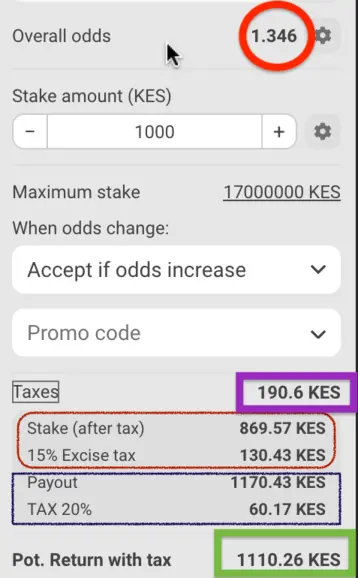
Understanding this evolution is essential, as it provides context for why tax-friendly or “no tax” betting sites have become a major area of interest among Kenyan punters.
Current Betting Tax Status in Kenya (2026)
As of 2026, Kenya’s betting tax system reflects the most recent changes introduced under the Finance Act 2025. These reforms significantly altered how betting is taxed, shifting from the older stake-and-winnings model to a wallet-based taxation system.
Under the current framework, the main taxes affecting punters are:
- 5% excise duty on deposits – charged when a user transfers money into their betting wallet
- 5% withholding tax on withdrawals – charged when funds are withdrawn from a betting account
In simple terms: players are taxed when they fund their account and again when they withdraw money, rather than directly on each bet or winning.
This system replaced the previous structure where punters were taxed at up to 15% on stakes and 20% on winnings, which had been widely criticized for creating a heavy tax burden on players. :contentReference[oaicite:0]{index=0}
The shift to the current model was formalized through amendments to the Excise Duty Act, which now define the taxable amount as the money deposited into a betting wallet rather than the amount staked. :contentReference[oaicite:1]{index=1}
At the same time, withholding tax on betting has been adjusted to apply to withdrawals at a rate of 5%, replacing the earlier 20% tax on winnings. :contentReference[oaicite:2]{index=2}
What This Means for Punters
- You are taxed when you deposit funds into your betting account
- You are taxed again when you withdraw funds
- The tax is no longer directly tied to individual bets or winnings
For example, if you deposit 1,000 KES, a 5% excise duty applies, and if you later withdraw your balance, a further 5% withholding tax is deducted. This means taxation is now based on money movement rather than betting outcomes.
Key takeaway: betting in Kenya is not tax-free. The current system applies taxes at the points of deposit and withdrawal, which is why many players look for betting platforms that reduce or offset these visible deductions.
It is also important to note that betting companies themselves remain subject to taxation, including tax on gross gaming revenue and corporate tax on profits, meaning the industry continues to operate under a multi-layered tax structure.
How Betting Tax Works via M-Pesa (Real User Flow)
In Kenya, most betting transactions are powered by M-Pesa, which means tax collection is closely tied to how money moves between your mobile wallet and your betting account. Over the past few years, the Kenya Revenue Authority (KRA) has worked with operators and payment providers to enable more real-time tax tracking and remittance.
While much of this happens behind the scenes through system integrations (such as Safaricom’s Daraja API), the easiest way to understand it is by looking at the actual player experience.
Step-by-Step: What Happens When You Bet Using M-Pesa
- You deposit money into your betting account
When you fund your account via M-Pesa, the transaction is processed instantly. Under the current system, a 5% excise duty is applied at this stage, meaning the amount that reaches your betting wallet is slightly reduced. - You place your bets as usual
Once the funds are in your account, you can place bets normally. Unlike the older system, tax is not directly applied per bet, which makes the betting experience feel cleaner and easier to track. - You withdraw your winnings
When you request a withdrawal back to M-Pesa, a 5% withholding tax is applied on the amount being withdrawn before it reaches your mobile wallet. - Tax is remitted automatically
The bookmaker’s system calculates and remits the applicable taxes to KRA, often in near real-time or through daily reconciliation processes. This happens automatically, without requiring any action from the player.
From a player’s perspective, betting tax in Kenya is now mostly “invisible” — it is applied during deposits and withdrawals rather than as a separate line item on every bet.
Behind the Scenes: KRA, M-Pesa & System Integration
To improve efficiency and compliance, KRA introduced system integrations that connect betting platforms with payment providers like Safaricom. Through services such as the Daraja API, betting companies are able to:
- Track betting-related transactions in real time
- Automatically calculate applicable taxes
- Remit taxes to KRA on a daily or near real-time basis
This shift from manual monthly reporting to automated remittance has made tax collection more efficient and has reduced delays in compliance.
What This Means for Players
- You do not need to manually pay betting tax
- All deductions happen automatically within deposits and withdrawals
- The tax impact is easier to miss, but still affects your overall balance
Key takeaway: when using M-Pesa, betting tax in Kenya is applied seamlessly in the background. This is why many punters look for betting sites that reduce the visible impact of these deductions through better odds, bonuses, or cashback offers.
iGaming Tax Regimes in Africa (2026 Overview)
Across Africa, betting taxation varies significantly by country. Some markets focus on taxing player winnings, while others place a heavier burden on operators through Gross Gaming Revenue (GGR) taxes. Below is a simplified snapshot of major iGaming tax frameworks in key African markets as of 2026.
| Country | Player-Level Taxes | Operator Taxes |
|---|---|---|
| Kenya | 5% on deposits; 5% on withdrawals | ~15% GGR tax + 30% corporate tax |
| Ghana | 10% withholding tax on winnings | ~20% GGR tax + additional levies |
| Nigeria | 5% withholding tax on winnings (resident players) | Varies by state; includes VAT + licensing fees |
| Uganda | 15% withholding tax on winnings | ~20% GGR tax |
| Tanzania | 10%–15% tax on winnings | ~25% GGR tax + VAT |
| Zambia | 15% withholding tax on winnings | ~25% GGR tax |
| South Africa | Limited (mainly horse racing winnings) | ~6–7% GGR tax + VAT (varies by province) |
| Zimbabwe | ~10% withholding tax on winnings | Additional operator-level taxes apply |
Key takeaway: most African countries tax either player winnings, operator revenue, or both. Kenya stands out by applying taxes directly on money movement (deposits and withdrawals), which makes the impact more noticeable to everyday users.
Key Observations Across African Markets
- Diverse tax models: Some countries tax winnings directly, while others focus more on operator revenue.
- Increasing regulation: Governments across Africa are tightening compliance and improving tax collection systems.
- Mobile-first ecosystems: Markets like Kenya rely heavily on mobile money, which influences how taxes are applied and collected.
- Competitive operator strategies: Many bookmakers adjust bonuses, odds, and promotions to remain attractive under different tax environments.
Offshore Betting Sites and “No Tax” Claims
When Kenyan punters search for betting sites in Kenya with no tax, some of them end up comparing offshore betting sites. In simple terms, offshore bookies are betting platforms that operate under a foreign licence or outside the main Kenyan licensing framework, often under jurisdictions such as Curaçao, Malta, the Isle of Man, or other international gaming hubs.
The main reason these platforms attract attention is straightforward: they may offer a different player experience from locally regulated betting sites. That can include broader markets, larger bonuses, more international payment options, and in some cases a betting experience where Kenyan tax deductions feel less visible to the user.
Important: “offshore” does not automatically mean “better” or “tax-free.” It usually means the platform operates under a different legal and commercial structure from a Kenya-focused bookmaker.
Why Some Kenyan Players Compare Offshore Bookies
- Different bonus structures: Offshore operators often compete aggressively on welcome offers, reload bonuses, and loyalty rewards.
- Broader betting markets: Some international platforms cover more leagues, events, virtuals, esports, and casino products than smaller local books.
- Alternative payment options: Many offshore sites support cards, bank transfers, e-wallets, and crypto, even where local mobile money support is limited.
- Different tax experience: Because Kenya now applies player-side taxes around deposits and withdrawals, some punters compare offshore brands when looking for a lower visible deduction experience.
Key Risks to Understand First
- Regulatory protection may be weaker for Kenyan users: If a dispute arises, you may not have the same practical recourse you would expect with a locally supervised operator.
- Payment friction is common: Deposits and withdrawals may take longer, cost more, or require methods that are less convenient than M-Pesa or Airtel Money.
- KYC and account checks can be stricter: Some offshore platforms require enhanced identity and payment verification before large withdrawals are processed.
- Availability can change: A site may accept Kenyan users today and change its market access, payment support, or terms later.
- Responsible gambling tools vary: Not every international operator offers the same quality of self-exclusion, deposit limits, or local-language support.
How to Evaluate an Offshore Bookie Safely
- Check which licensing authority appears in the footer and verify that it is real and current.
- Read the payments, KYC, and withdrawal rules before depositing.
- Confirm whether the site clearly states that it accepts players from Kenya.
- Look for transparent terms on bonus rollover, withdrawal timing, and maximum cashout.
- Start small before committing larger deposits.
Best way to think about offshore sites: they are an alternative worth comparing, not an automatic upgrade. The real test is whether the bookmaker combines trustworthy licensing, workable payments, fair withdrawal rules, and a user experience that genuinely offers better value.
For most readers, the smartest approach is to compare offshore bookmakers carefully against the stronger tax-friendly betting sites already listed above. In many cases, a site with local payment support, smoother withdrawals, and transparent promotions may still offer the better overall experience — even if an offshore bookie looks more attractive at first glance.
Retail Sportsbooks in Kenya
While online betting dominates the Kenyan market today, retail (physical) sportsbooks are still widely available across the country. These are brick-and-mortar betting shops where punters can place bets in person and receive a printed ticket for their wagers.
Major betting brands operating in Kenya — such as SportPesa, Mozzart Bet, and others — maintain physical outlets in major towns and urban centres. These shops provide an alternative for players who prefer face-to-face transactions or do not have consistent access to mobile devices or internet services.
How Retail Betting Works
- You visit a physical betting shop
- Select your matches or markets
- Place your bet with a cashier
- Receive a printed betting slip (ticket)
- Return with the ticket to claim your payout if you win
In some cases, winnings can also be credited to your online betting account if your profile is linked to the operator’s digital platform.
Do Retail Betting Shops Avoid Tax?
No. Betting taxes in Kenya apply regardless of whether you place your bet online or in a physical shop. The taxation framework is tied to the operator and the transaction flow, not the betting channel.
Key takeaway: using a retail sportsbook does not eliminate betting tax. Whether you bet online or in person, the applicable taxes are still factored into the system.
That said, most Kenyan punters today prefer online betting due to its convenience, faster payments (especially via M-Pesa), and access to a wider range of markets and promotions.
Safety When Using Online Betting Sites
When using online betting platforms, it is important to prioritize your safety and protect both your personal information and your funds. Whether you are using a local or international bookmaker, the following best practices can help you stay secure.
- Use reputable platforms: Choose well-known betting sites with clear licensing information and a strong track record.
- Check for secure connections: Always ensure the website uses HTTPS (look for the padlock icon in your browser).
- Use strong passwords: Create unique passwords with a mix of letters, numbers, and symbols.
- Enable two-factor authentication (2FA): This adds an extra layer of protection to your account.
- Avoid suspicious tools: Stay away from “betting hacks,” bots, or third-party tools promising guaranteed wins.
- Watch for phishing scams: Do not click unknown links or share login details via email or social media.
- Set limits: Use deposit and betting limits to control your spending.
- Practice responsible gambling: Only bet what you can afford to lose.
Key takeaway: the safest betting experience comes from using trusted platforms, protecting your account, and maintaining full control over your spending habits.
Betting Apps and Access Considerations
Many betting platforms today offer dedicated mobile apps, which provide a faster, more stable, and more secure experience compared to using a browser. For most users in Kenya, official apps from licensed or reputable operators are the safest way to access betting services.
Some players explore alternative access methods when certain platforms have limited availability or payment restrictions. However, it is important to understand that:
- Account verification (KYC) is strict: Most bookmakers require identity verification before withdrawals.
- Access methods must match account details: Mismatched location or identity information can lead to delays or blocked withdrawals.
- Terms and conditions apply: Using a platform in a way that violates its terms can result in account restrictions.
For this reason, the safest approach is to use betting platforms that clearly support players in your region and provide transparent rules on deposits, withdrawals, and verification.
Key takeaway: official apps and supported access methods are generally safer than workarounds. Always prioritize platforms that offer clear policies and reliable payment systems.
Final Verdict: Are There Betting Sites With No Tax in Kenya?
The idea of “betting sites in Kenya with no tax” is largely a matter of perception rather than a literal reality. As of 2026, Kenya applies betting-related taxes primarily at the points of deposit and withdrawal, meaning that all licensed betting activity operates within a taxed environment.
What many players are actually looking for are tax-friendly betting sites — platforms that reduce the visible impact of these deductions through better odds, bonuses, cashback offers, or overall user experience.
Throughout this guide, we have explored:
- The top betting sites available to Kenyan players
- How betting tax works under the current system
- The difference between local and offshore platforms
- How payments and tax deductions happen in practice
The best approach is not to chase “no tax” claims blindly, but to choose platforms that offer:
- Reliable payments (especially M-Pesa support)
- Transparent terms and conditions
- Strong bonuses and fair odds
- A smooth and trustworthy user experience
Bottom line: there are no truly tax-free betting sites in Kenya under current law — but there are smarter choices that can help you keep more value from your bets.